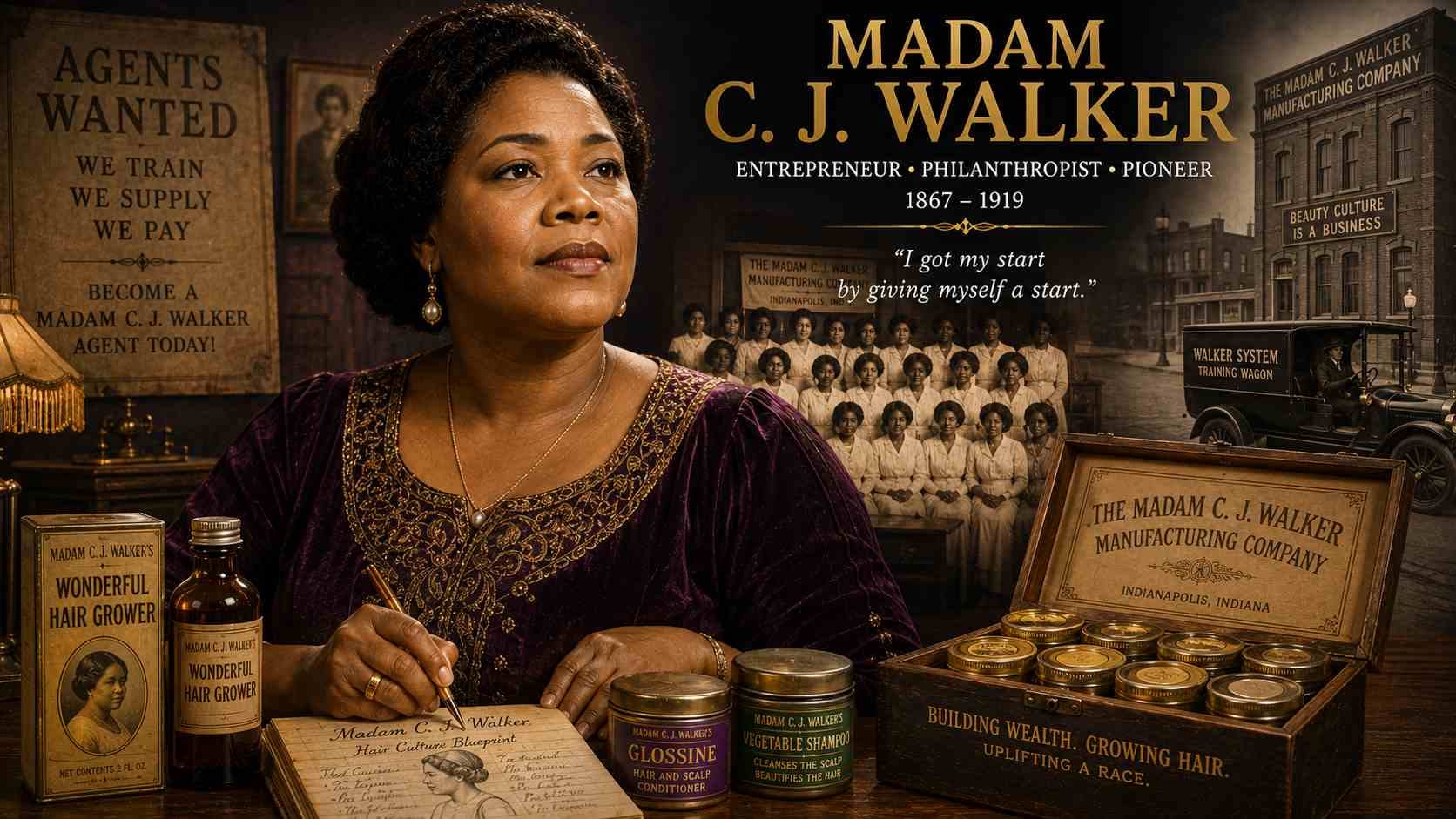
Sarah Breedlove was born on 23 December 1867 in Delta, Louisiana — the first child in her family born free after emancipation. Orphaned at seven, married at fourteen and widowed at twenty, she arrived in St Louis with almost nothing and a daughter to raise alone. She washed laundry for a living and earned little more than a dollar a day.
In her thirties, struggling with a scalp condition that was causing her hair to fall out, Sarah Breedlove began experimenting with hair care products. After working as a sales agent for Annie Malone's Poro Company, she developed her own formula and launched her business in Denver in 1906 under the name Madam C.J. Walker — taking the name of her third husband, Charles Joseph Walker.
What followed was one of the most remarkable business stories in American history. Madam Walker built a nationwide sales force of thousands of Black women — called Walker Agents — who sold her products door to door across America, the Caribbean and Central America. She trained them, paid them well and created economic independence for women who had few other opportunities. At a time when Black women were confined to domestic service, she gave them a path to financial dignity.
By 1917, Madam Walker had become the first American woman — of any race — to become a self-made millionaire. She built a factory in Indianapolis, established Lelia College to train her agents, and constructed a magnificent mansion called Villa Lewaro in Irvington, New York. Her philanthropy was extraordinary — she funded scholarships, supported the NAACP's anti-lynching campaign and donated generously to Black educational institutions.
Madam C.J. Walker died on 25 May 1919, aged 51, having transformed not only her own life but the lives of thousands of Black women across America. She proved that enterprise, vision and sheer determination could overcome every barrier that a racist society could erect.
- First American woman — of any race — to become a self-made millionaire
- Built a sales force of over 40,000 Walker Agents across America, the Caribbean and Central America
- Founded the Madam C.J. Walker Manufacturing Company — one of the most successful Black-owned businesses in US history
- Funded the NAACP anti-lynching campaign and multiple Black educational institutions
- Inducted into the National Women's Hall of Fame
- Commemorated on a US postage stamp in 1998
- Start where you are. Walker began as a laundress earning a dollar a day. She did not wait for better circumstances — she transformed the circumstances she had.
- Build others up. Her greatest achievement was not her own fortune but the economic independence she created for thousands of Black women through her Walker Agent programme.
- Invest in your community. At the height of her success she gave generously to schools, civil rights organisations and anti-lynching campaigns. Wealth without purpose is incomplete.
- Define yourself. She chose her own name, built her own brand and created her own story. No one gave her permission. She did not wait for it.