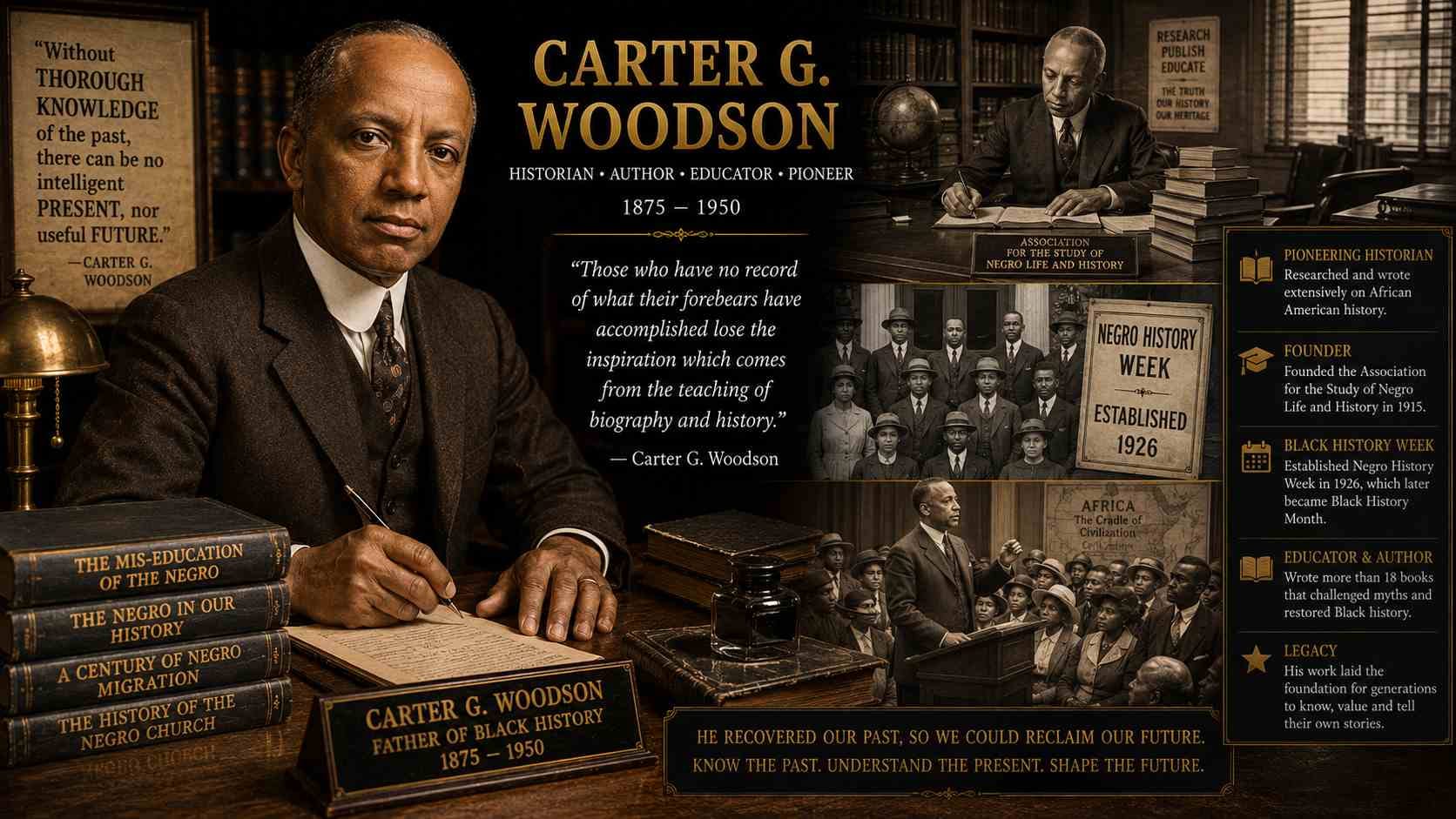
Carter Godwin Woodson was born on 19 December 1875 in New Canton, Virginia, the son of formerly enslaved parents. He grew up in poverty so severe that he was unable to attend school regularly until he was nearly twenty years old — instead working in the coal mines of West Virginia from the age of seventeen to support his family. When he finally did enter formal education, he completed four years of high school in less than two years. His hunger for knowledge was unstoppable.
Woodson went on to earn a BA from Berea College in Kentucky and an MA from the University of Chicago. In 1912, he received a PhD in History from Harvard University — becoming only the second Black American in history to earn a doctorate from that institution, after W.E.B. Du Bois. His doctoral dissertation on the Reconstruction period of American history was a work of meticulous scholarship that challenged the prevailing racist narrative of that era.
In 1915, Woodson founded the Association for the Study of Negro Life and History (ASNLH) — an organisation dedicated to researching and promoting the achievements of Black Americans, which historians had systematically ignored or distorted. The following year he launched the Journal of Negro History, which published rigorous academic scholarship on Black history and culture at a time when mainstream journals refused to do so.
In 1926, Woodson established Negro History Week — the second week of February, chosen to coincide with the birthdays of Frederick Douglass and Abraham Lincoln. His aim was simple and revolutionary: to ensure that Black Americans and their contributions to civilisation were recognised, celebrated and never forgotten. Negro History Week became Black History Month in 1976 — now observed across the United States, United Kingdom, Canada and beyond.
Carter G. Woodson never married. He devoted his entire life to the cause of historical recovery. He founded and ran his own publishing house, wrote fourteen books, and edited numerous others — all in service of the belief that a people without knowledge of their history is like a tree without roots. He died on 3 April 1950 in Washington D.C., aged 74, having given the world its memory back.
- Founded the Association for the Study of Negro Life and History (1915) — still active today as the ASALH
- Established Negro History Week (1926) — which became Black History Month
- Second Black American to earn a PhD from Harvard University
- Founded and edited the Journal of Negro History for 35 years
- Author of 14 books on Black history and culture
- US postage stamp issued in his honour (1984)
- Knowledge is power — and so is its absence. Woodson understood that those who control the narrative control the future. Fight for your story to be told accurately.
- Start your own institution. When mainstream publishers and journals refused to recognise Black scholarship, Woodson built his own. Don't wait for permission. Build the platform.
- Sacrifice for the long game. Woodson devoted his entire life — never marrying, spending every resource he had — to a cause whose full impact would only be felt generations later. Some investments take time.
- Never accept the history you are given. Woodson refused to accept a version of history that erased his people. Question what you are taught. Seek the fuller truth.