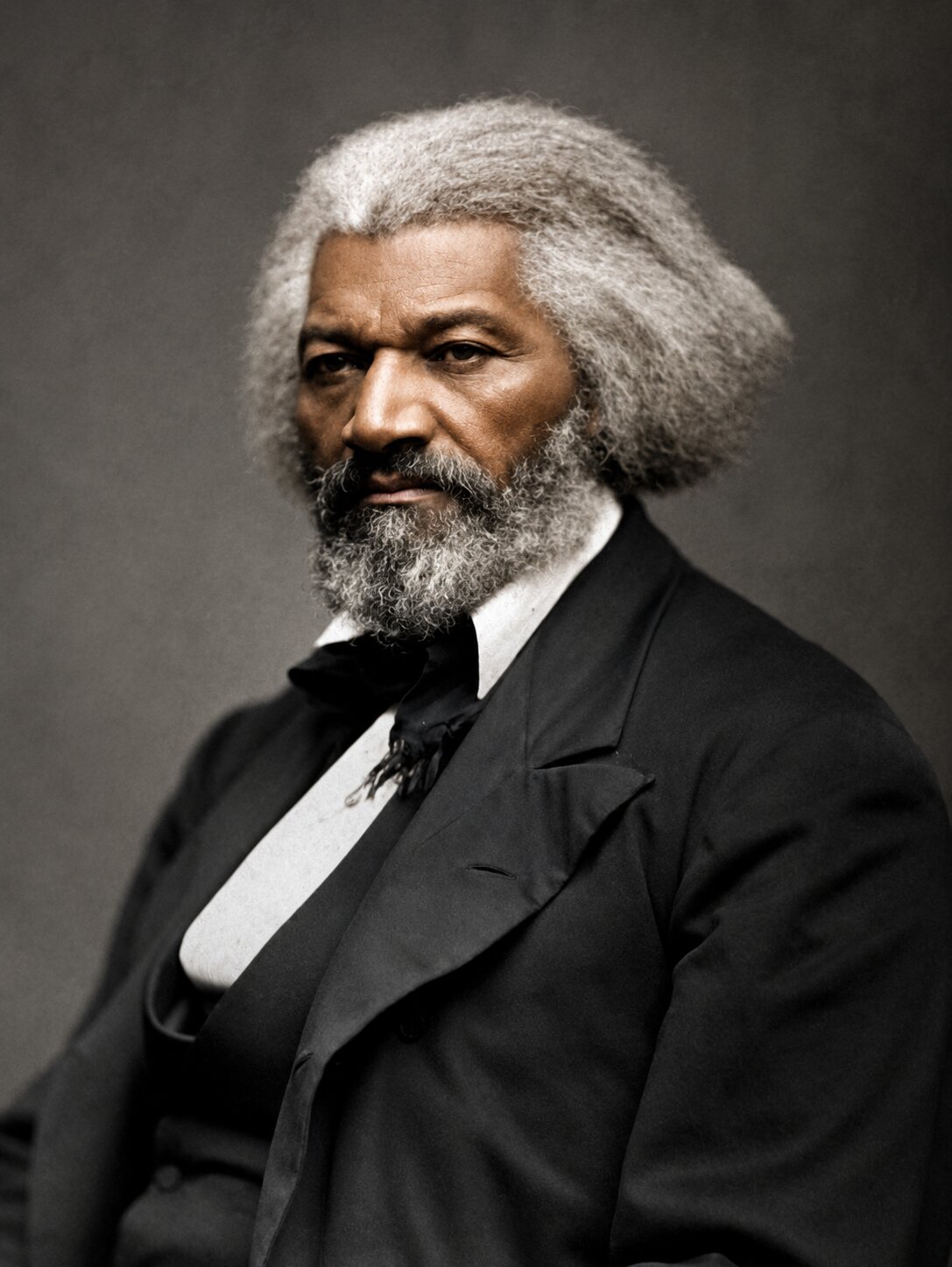
Frederick Douglass was born into slavery in Talbot County, Maryland, around February 1818. He never knew his exact birth date — a deliberate cruelty of the slave system, which denied enslaved people even knowledge of when they were born. His mother, Harriet Bailey, was an enslaved woman. His father was almost certainly a white man, possibly his owner.
As a young enslaved man in Baltimore, Douglass taught himself to read and write — an act of extraordinary defiance in a society that made Black literacy illegal. He absorbed everything he could find to read and began to understand, with increasing clarity, the injustice of his situation. 'Once you learn to read,' he later wrote, 'you will be forever free.'
In 1838, at the age of 20, Douglass escaped from slavery disguised as a sailor, travelling by train to New York. He settled in New Bedford, Massachusetts, and began attending abolitionist meetings. His eloquence and his first-hand testimony about the realities of slavery made him an immediate sensation.
In 1845, Douglass published Narrative of the Life of Frederick Douglass, an American Slave — one of the most powerful autobiographies ever written. It became an international bestseller. He travelled to Britain and Ireland, where he lectured to packed audiences and was warmly received. British supporters purchased his freedom for £150.
Douglass went on to become the most prominent African-American of the 19th century. He advised Abraham Lincoln during the Civil War, advocated for Black soldiers' rights, campaigned for women's suffrage, served as US Marshal for Washington D.C. and was appointed US Minister to Haiti. He died on 20 February 1895, having attended a women's rights meeting that very day.
- Escaped from slavery and became the most influential Black abolitionist in American history
- Published three autobiographies, all bestsellers
- Advised President Abraham Lincoln during the Civil War
- First African-American nominated for Vice President of the United States (1872)
- US Marshal for Washington D.C.
- US Minister to Haiti
- Lifelong advocate for women's suffrage as well as racial equality
- Founded and edited The North Star — a leading abolitionist newspaper
- Literacy is the first act of liberation.. Douglass taught himself to read in secret. Every book he read widened the gap between what he was told he was and what he knew he could be.
- Your voice is your power.. Douglass became the most compelling speaker of his age. He used his voice to change laws, change minds and change history.
- Document your suffering and your triumph.. His three autobiographies ensure that the truth of slavery — and the possibility of transcending it — is permanently recorded.
- Fight on every front.. Douglass campaigned for racial equality AND women's suffrage. Justice is indivisible.