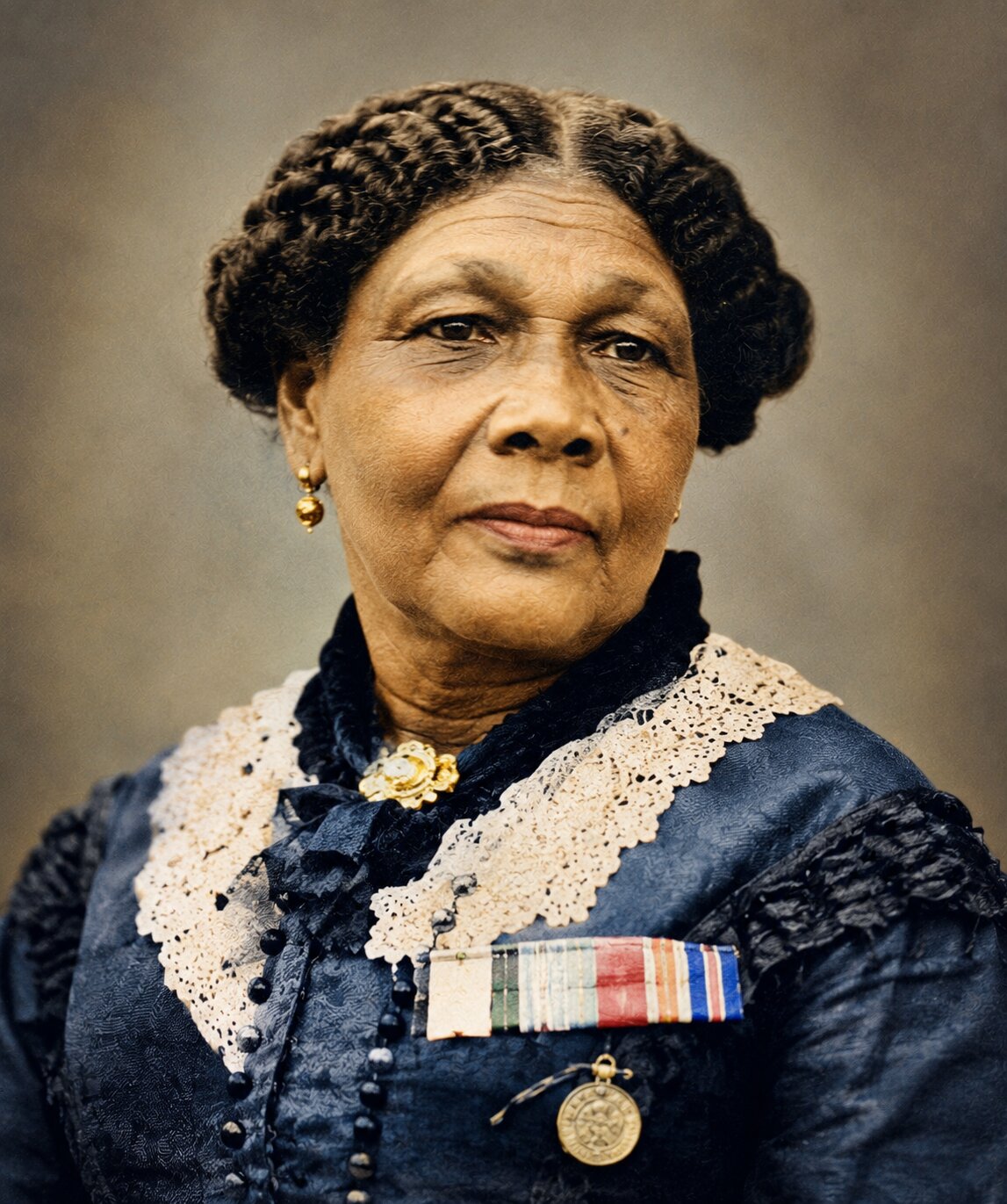
Mary Jane Seacole was born Mary Jane Grant in Kingston, Jamaica in 1805. Her mother was a Jamaican woman who ran a boarding house and practised traditional Caribbean medicine, and her father was a Scottish soldier. From her mother, Mary learned the art of healing — using local herbs and remedies to treat the sick and injured — skills that would define her extraordinary life.
After the death of her husband Edwin Horatio Hamilton Seacole in 1836, Mary threw herself into nursing and travel. She visited Panama, where she treated victims of a cholera epidemic, and returned to Jamaica to fight yellow fever outbreaks. Her reputation as a skilled and compassionate healer grew across the Caribbean.
When the Crimean War broke out in 1853, Mary travelled to London and applied to join Florence Nightingale's team of nurses being sent to the front. She was rejected — almost certainly because of her race. Undeterred, she funded her own passage to the Crimea and established the British Hotel near Balaclava — a place of rest and recovery where she nursed wounded soldiers, often under fire, at her own expense.
Soldiers called her "Mother Seacole" and she became one of the most celebrated women of the Crimean War. After the war she returned to England in financial ruin, but a fundraising festival in her honour attended by thousands restored her fortunes. She published her autobiography, Wonderful Adventures of Mrs Seacole in Many Lands, in 1857 — one of the first autobiographies written by a Black woman in Britain.
Mary Seacole died in London in 1881. In 2004, she was voted the Greatest Black Briton in a public poll. In 2016, a statue of her was unveiled outside St Thomas' Hospital in London — the first statue of a named Black woman in the United Kingdom.
- First Black woman to nurse soldiers on a British battlefield
- One of the first authors of a Black woman's autobiography in Britain (1857)
- Treated cholera and yellow fever victims across the Caribbean and Panama
- Funded her own medical mission to the Crimean War after being denied by the British War Office
- Voted Greatest Black Briton in 2004
- First Black woman to have a statue erected in her honour in the United Kingdom (2016)
- Awarded the Crimean Medal, the French Légion d'honneur and the Turkish Medjidie Order
- Rejection is redirection. When the door is closed, find another way in. Mary was refused by the War Office and went anyway — at her own expense.
- Your skills are your passport. Mary's medical knowledge transcended every barrier placed before her. Mastery commands respect.
- Document your story. Her autobiography ensured her legacy survived. Tell your own story — don't leave it to others.
- Service is the highest calling. She nursed soldiers under fire, often at personal risk. She led from the front, literally.
2. How did Mary Seacole respond to rejection? What can we learn from her approach?
3. Why do you think it took until 2016 — over 130 years after her death — for a statue of Mary Seacole to be erected in Britain?