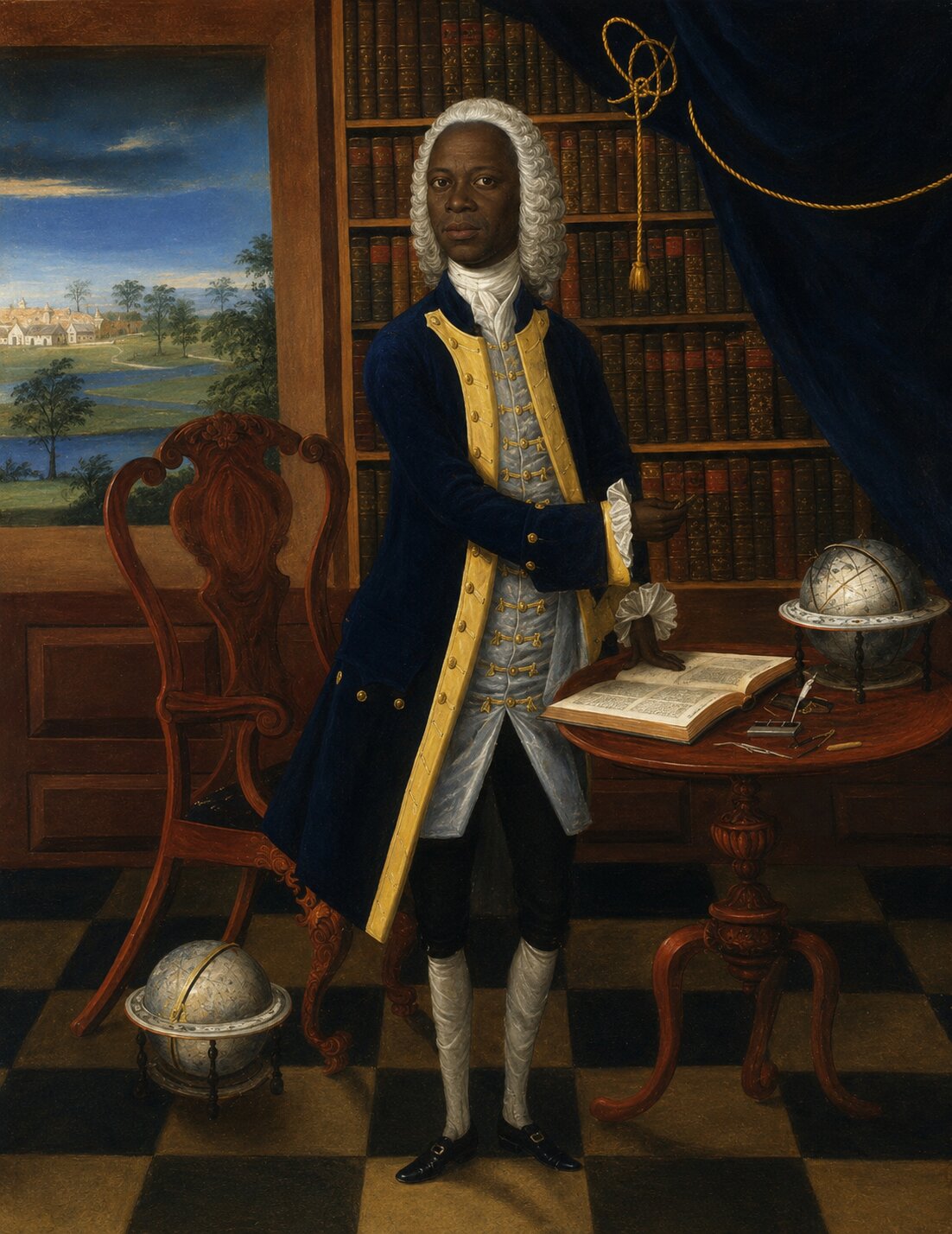
Francis Williams was born around 1702 in Kingston, Jamaica, the son of free Black parents John and Dorothy Williams. His father was a successful tradesman who had gained his freedom and established himself in Jamaican society. Francis was selected as a young boy by the Duke of Montagu for a remarkable social experiment — to test whether a Black child, given the same education as a white child, could equal his white contemporaries in intellectual achievement.
Funded by the Duke of Montagu, Francis Williams was sent to England to be educated, and the story that circulated in his lifetime and after held that he went on to study at Cambridge University. This account originates with Edward Long, an 18th-century Jamaican historian and vocal defender of slavery, who described Williams as the subject of a deliberate "experiment" to test whether a Black man could match a white man's education. No record of Williams's attendance survives in Cambridge's own archives, and modern historians increasingly question whether he studied there at all — some suggesting his family's own wealth, rather than a Cambridge education, funded the rigorous training in mathematics and classics he demonstrably possessed. Whatever its precise origin, that education was real: his command of Latin, mathematics and astronomy was widely acknowledged even by hostile contemporaries, and his success directly challenged the prevailing belief that Black people were intellectually inferior.
After completing his education, Williams returned to Jamaica where he established a school and became a celebrated teacher. He also became known as a poet, writing in Latin — the language of scholars — and producing odes celebrating British governors of Jamaica. His poetry demonstrated a mastery of classical form that confounded those who doubted Black intellectual capacity.
Williams was a complex and sometimes controversial figure. He was proud, assertive and acutely aware of his own significance. The historian Edward Long, a defender of slavery, wrote disparagingly about him — but his very hostility is evidence of how threatening Williams' achievement was to the ideology of racial inferiority.
Francis Williams died around 1770. His portrait — one of the earliest known portraits of a Black man in the Americas — survives and shows him in a scholarly setting, surrounded by books, holding a paper inscribed with Latin verse. It is a powerful image of Black intellectual authority.
- Reputedly among the first Black students at Cambridge University, though no attendance record survives
- Pioneering Black poet writing in classical Latin
- Founded one of Jamaica's earliest schools
- His portrait is one of the earliest known images of a Black man in the Americas
- Directly challenged prevailing theories of Black intellectual inferiority through his academic achievements
- Education is the greatest act of resistance.. In an era when Black people were denied learning, Williams pursued the highest education available. Knowledge is power in its purest form.
- Excellence is the most devastating argument.. Williams didn't argue against racism — he rendered it absurd through his achievements.
- Teach what you know.. Williams returned home from England and built a school. He understood that individual achievement must become collective uplift.
- Your portrait matters.. Williams sat for a formal portrait in a scholarly setting. He claimed his place in history through image as well as achievement.