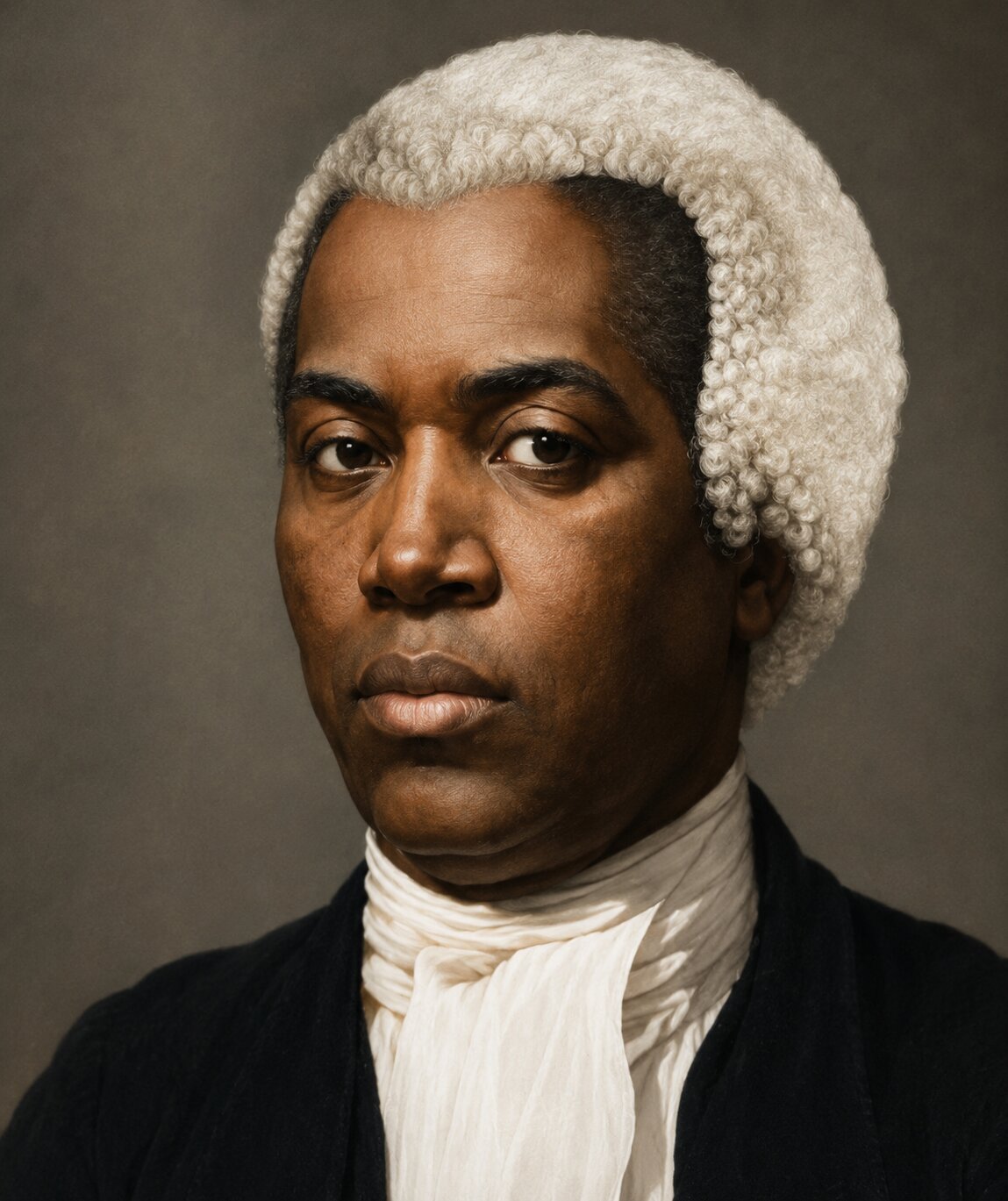
Benjamin Banneker was born on 9 November 1731 in Baltimore County, Maryland, to a free Black family. His grandmother, Molly Welsh, was an English woman who had been transported to America as an indentured servant. She later purchased and freed two enslaved men, one of whom — Banneka — she married. Benjamin was their grandson.
Largely self-taught, Banneker demonstrated extraordinary mathematical and intellectual ability from an early age. As a young man, he built a wooden clock — entirely from scratch, having studied only a borrowed pocket watch — that kept accurate time for over 40 years. It was one of the first clocks made entirely in America.
In 1791, Banneker was recruited to assist in the survey of the District of Columbia — the new capital of the United States. When the lead surveyor, Pierre Charles L'Enfant, abruptly left the project taking his plans with him, Banneker is said to have reproduced the entire layout of the city from memory, saving the project.
From 1792 to 1797, Banneker published a series of almanacs containing astronomical calculations, weather forecasts and tide tables — becoming the first African-American to publish a scientific work. He sent a copy to Thomas Jefferson along with a powerful letter challenging Jefferson's belief in the intellectual inferiority of Black people. Jefferson wrote back acknowledging his accomplishments.
Benjamin Banneker died on 9 October 1806. His legacy as a mathematician, astronomer, engineer and advocate for racial equality makes him one of the most important figures in American intellectual history — and a foundational figure in the history of Black scientific achievement.
- Built one of the first clocks made entirely in America (c.1753)
- First African-American to publish a scientific almanac (1792)
- Assisted in the survey and design of Washington D.C. (1791)
- First Black person to challenge Thomas Jefferson directly on racial equality in writing
- Self-taught mathematician and astronomer — entirely without formal education
- Published six almanacs between 1792 and 1797
- Self-education is the most powerful education.. Banneker had no formal schooling yet became a mathematician, astronomer and engineer. Curiosity and determination can replace any classroom.
- Speak truth to power.. His letter to Thomas Jefferson is one of the most powerful documents in American history. He said what needed to be said, to the person who needed to hear it.
- Document your work.. His almanacs ensured his legacy survived. Published work endures when memory fades.
- Age is no barrier.. Banneker taught himself astronomy at 57. It is never too late to learn something extraordinary.