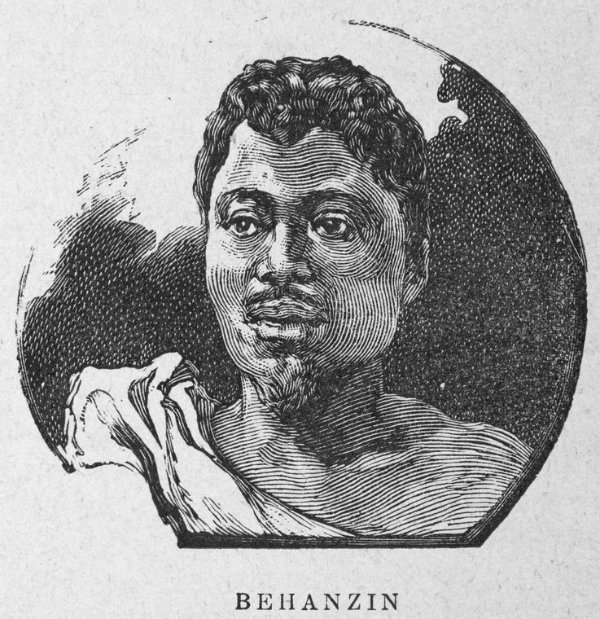
Béhanzin, born Kondo, became the eleventh king of Dahomey in 1889 following the death of his father, King Glele, inheriting a powerful West African kingdom already facing mounting pressure from French colonial expansion along the coast.
Béhanzin commanded a formidably modernised army, including the famed Agojie, an elite corps of all-female warriors sometimes called the Dahomey Amazons, equipped with German-supplied rifles and trained in disciplined military tactics that made them a serious force against European colonial armies.
When France pushed to formally annex Dahomey in 1892, Béhanzin led sustained, fierce resistance across the Franco-Dahomean Wars, fighting pitched battles at Dogba, Poguessa and the Oueme Valley, inflicting significant casualties on French forces despite their superior weaponry.
Béhanzin was ultimately defeated in 1894 and exiled by France, first to Martinique and later to Algeria, where he died in 1906. He remains celebrated today as one of West Africa's most significant symbols of anti-colonial resistance, and his remains were repatriated to Benin in 1928.
- Led sustained, fierce military resistance against French colonial conquest for years
- Commanded the Agojie, a formidable elite corps of all-female warriors
- Modernised his army with European firearms to better resist colonial conquest
- Inflicted significant casualties on French forces despite their technological advantage
- Remains one of West Africa's most celebrated symbols of anti-colonial resistance
- Military modernisation can meaningfully extend resistance against superior forces. His acquisition of modern firearms allowed sustained resistance despite France's technological advantage.
- Innovative military structures can become legendary in their own right. The Agojie warriors he commanded remain one of history's most remarkable military units.
- Resistance carries lasting symbolic significance even without ultimate victory. His defeat did not diminish his status as a defining symbol of anti-colonial resistance.
- National memory can restore honour even after prolonged exile. His remains' repatriation decades after his death reflected Benin's enduring recognition of his significance.